
Medicare Part D Changes for 2024
By Jay Rayl — Medicare Made Simple & TLC Insurance Group
The Inflation Reduction Act of 2022 has several items designed to lower the cost of prescription medications for Medicare recipients and also reduce the amount that Medicare itself spends. The most popular benefit includes a cap on out-of-pocket drug spending for enrollees in Medicare Part D plans and requiring Part D plans and drug manufacturers to pay a greater share of costs for enrollees with high drug costs.
What Does the Medicare Part D Benefit Look Like in 2023?
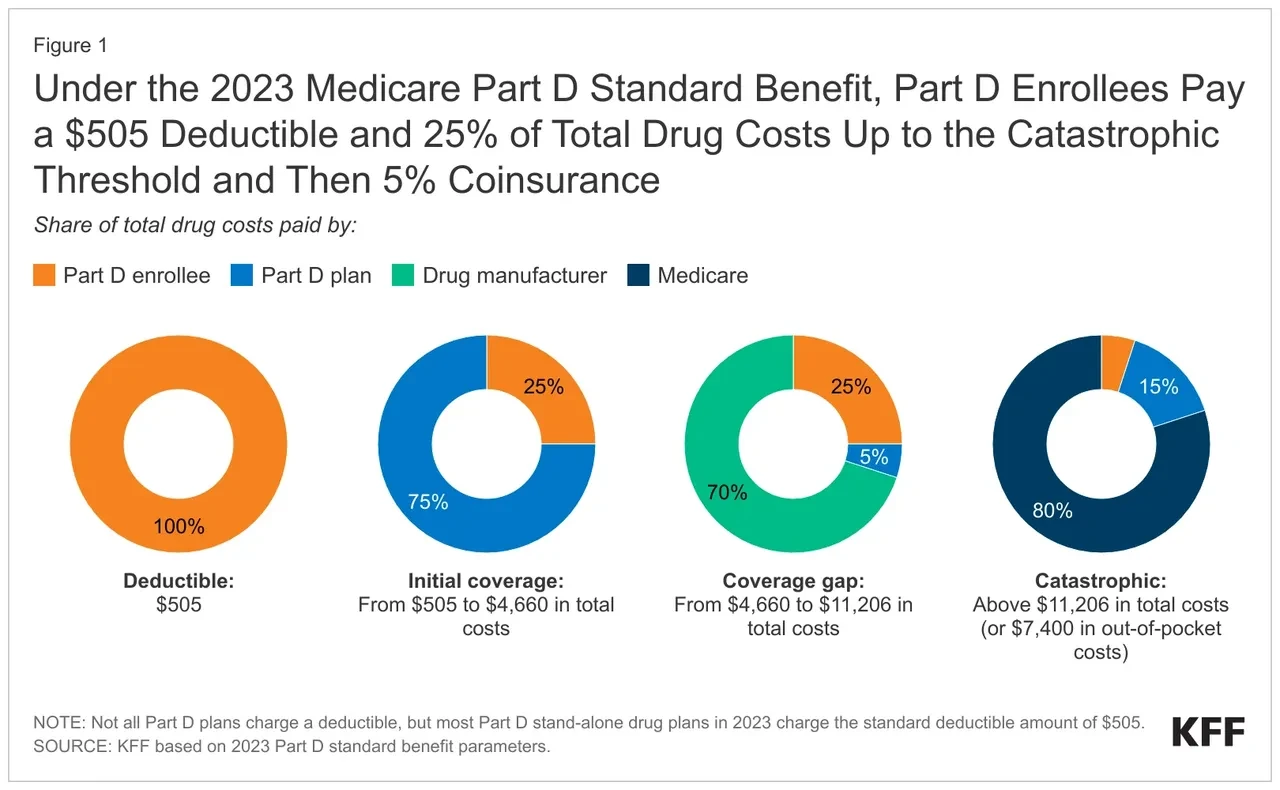
The standard design of the Medicare Part D benefit currently has four distinct phases, where the share of drug costs paid by Part D enrollees, Part D plans, drug manufacturers, and Medicare varies.
- Deductible phase: Part D enrollees pay 100% of their drug costs, up to $505 in 2023.
- Initial coverage phase: Part D enrollees pay 25% of total drug costs and Part D plans pay 75%, up to total drug costs of $4,660 in 2023. Most plans charge a mix of copayments and coinsurance — for example, $4 for a tier 1 generic, $8 for a tier 2 generic, $45 for a tier 3 preferred brand, $95 for a tier 4 non-preferred drug, and 25% for a tier 5 specialty drug.
- Coverage gap phase: Part D enrollees pay 25% of total drug costs for both brand-name and generic drugs. Part D plans pay the remaining 75% of generic drug costs and 5% of brand drug costs, and drug manufacturers provide a 70% price discount on brands.
- Catastrophic phase: Medicare pays 80% of total drug costs, Part D plans pay 15%, and Part D enrollees pay 5%. In 2023, the catastrophic threshold is set at $7,400.
How Is the Medicare Part D Benefit Changing in 2024?
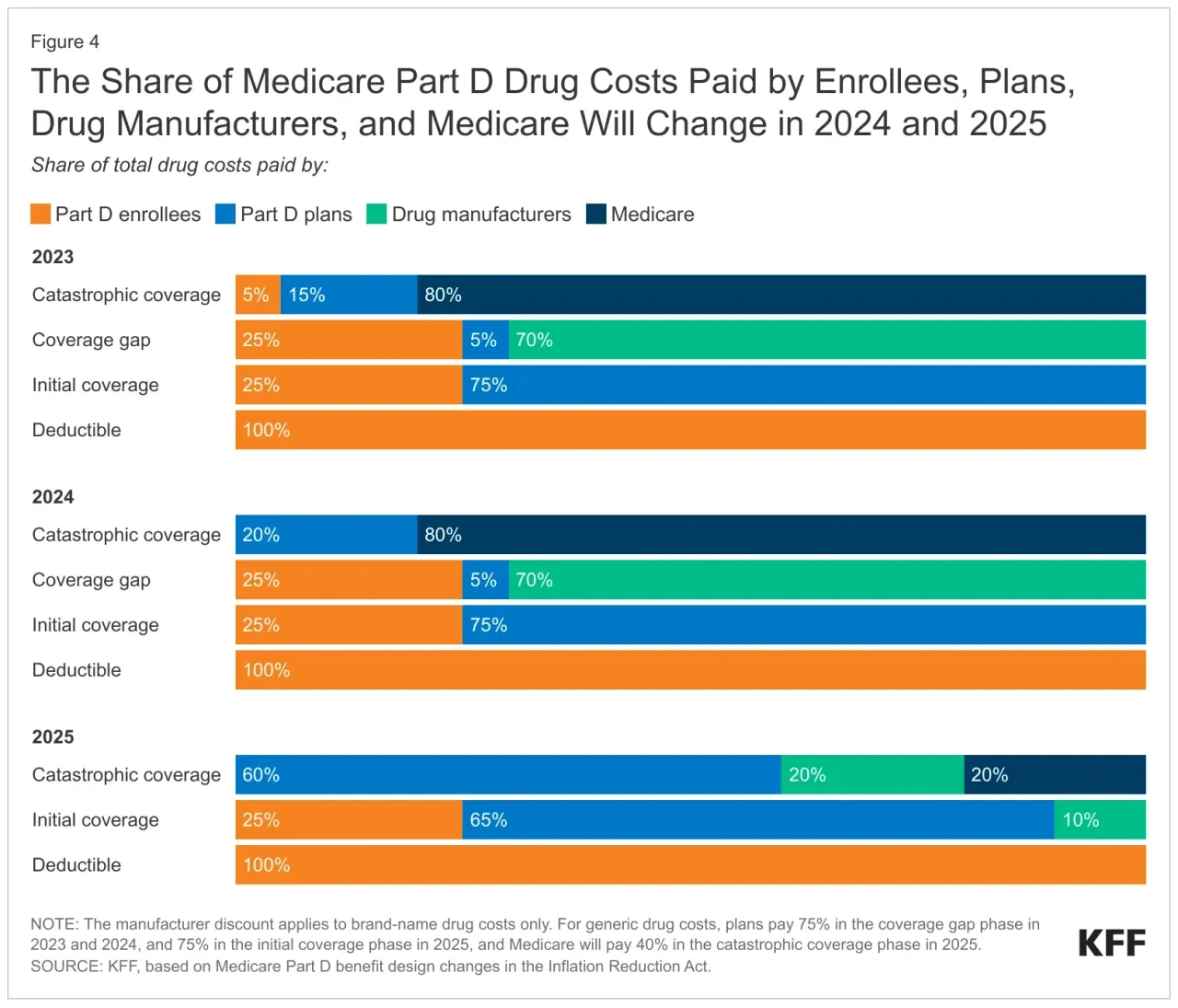
In 2024, costs in the catastrophic phase will change: the 5% coinsurance requirement for Part D enrollees will be eliminated and Part D plans will pay 20% of total drug costs in this phase instead of 15%. The limits will also change:
- Deductible: $545 (up from $505 in 2023)
- Initial coverage limit: $5,030 (up from $4,660 in 2023)
- Out-of-pocket threshold: $8,000 (up from $7,400 in 2023)
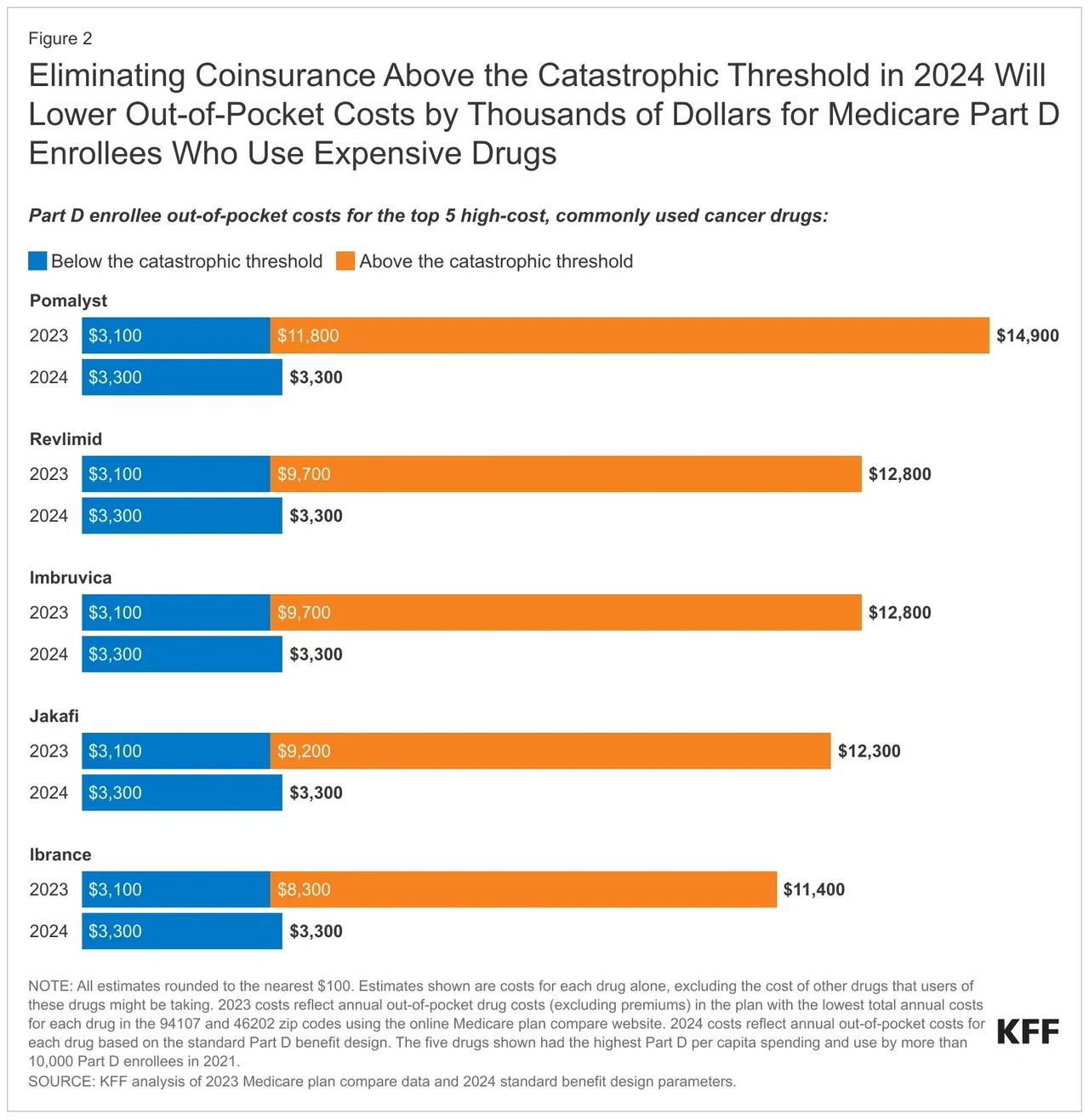
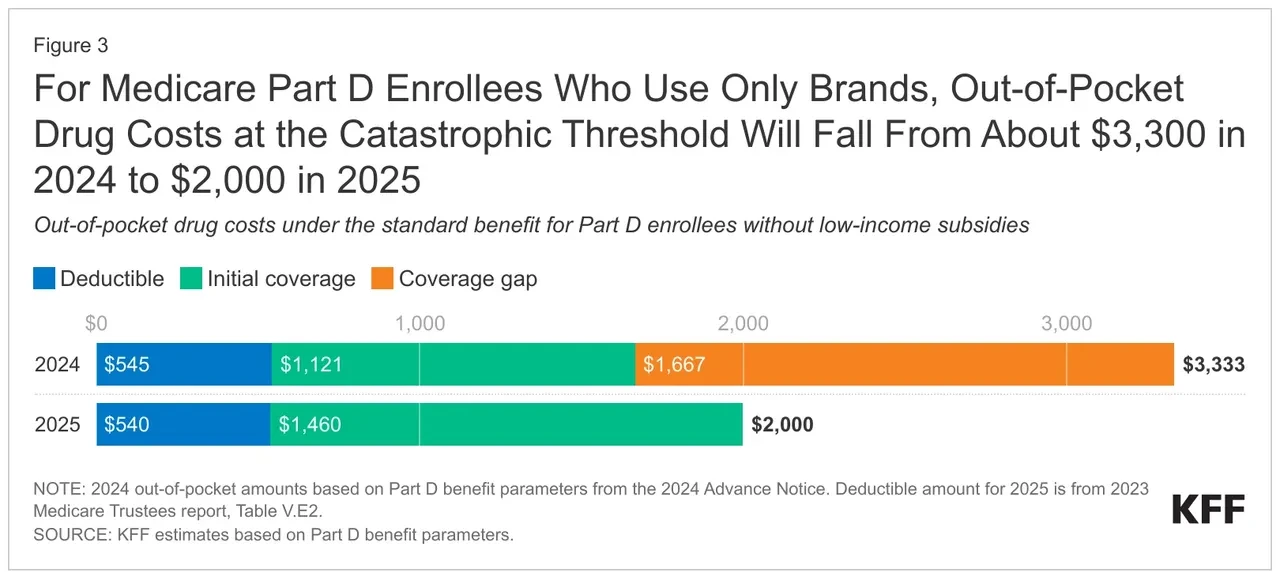
Once Part D enrollees reach catastrophic coverage in 2024, they will no longer be required to pay 5% of their drug costs. For Part D enrollees who take only brand-name drugs, annual out-of-pocket costs at the catastrophic threshold will be about $3,300 before they face no additional costs for their medications.
For high-cost medications like Revlimid, Pomalyst, Imbruvica, Jakafi, and Ibrance — all cancer treatments — annual out-of-pocket costs per drug in 2023 range from over $11,000 to nearly $15,000. Eliminating the 5% coinsurance requirement in 2024 means enrollees using these medications will see thousands of dollars in savings.
How Is the Medicare Part D Benefit Changing in 2025?
Changes in 2025 include a new $2,000 out-of-pocket spending cap, elimination of the coverage gap phase, a higher share of drug costs paid by Part D plans in the catastrophic phase, and changes to plan costs and the manufacturer price discount in the initial coverage phase.
- $2,000 out-of-pocket cap: Beginning in 2025, Part D enrollees' out-of-pocket drug costs will be capped at $2,000. This amount will be indexed to rise each year after 2025 at the rate of growth in per capita Part D costs. Note: this cap does not apply to out-of-pocket spending on Part B drugs.
- Coverage gap eliminated: The coverage gap phase will be eliminated in 2025, meaning Part D enrollees will no longer face a change in their cost sharing when they move from the initial coverage phase to the coverage gap phase.
- Catastrophic phase changes: Medicare's share of total costs in the catastrophic phase will decrease from 80% to 20% for brand-name drugs and from 80% to 40% for generic drugs. Part D plans' share will increase from 15% to 60% for both brands and generics above the cap.
- Initial coverage phase changes: Drug manufacturers will be required to provide a 10% discount on brand-name drugs in the initial coverage phase beginning in 2025. Part D plans will pay 65% of brand-name drug costs.
Other Changes to Part D
- As of 2023, the out-of-pocket cost of insulin products is limited to no more than $35 per month in all Part D plans.
- Adult vaccines covered under Part D, such as the shingles vaccine, are covered with no cost sharing.
- Starting in 2024, people with Medicare who have incomes up to 150% of poverty will be eligible for full benefits under the Part D Low-Income Subsidy (LIS) Program.
- Starting in 2025, Part D enrollees will have the option of spreading out their out-of-pocket costs over the year.
How Are These Changes Expected to Affect Plans and Premiums?
One of the biggest concerns in the Medicare insurance industry right now is how these new mandates will affect the insurance companies' ability to offer their benefits. While CMS has stated they expect the average monthly premium to go down, they are using metrics that most people do not look at. We expect the Part D plans most clients look to for prescription coverage to rise by larger rates than we have ever seen.
For members who utilize traditional Medicare Supplement plans (MediGap), they will most likely see much higher rates in their "Stand Alone" Part D plan — there is nowhere to hide the increased cost other than the plan premium. Members who participate in a Medicare Advantage plan may not see any premium increase but should expect to see a slowdown in the benefit enhancements we have seen over the past few years.
For members who have large prescription drug costs, these changes to the Part D system are going to be a life changer. As plan premiums continue to rise, it is important to do annual reviews to make sure your health plan is still the right fit for your individual needs.
Much of this information was sourced from kff.org. Additional information was added by MMS. Original article by Juliette Cubanski and Tricia Neuman.
Have questions about your plan?
Call us at 440-613-0083. We're always here to help simplify your healthcare process.